
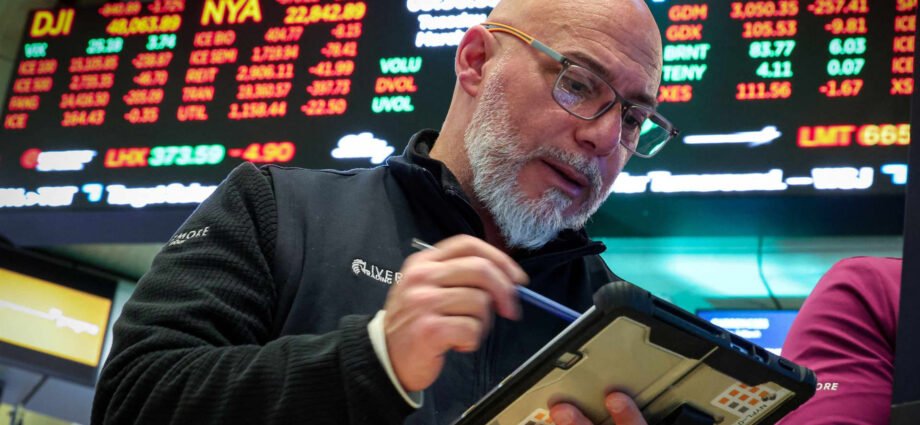
Traders work on the floor at the New York Stock Exchange (NYSE) in New York City, U.S., March 3, 2026. REUTERS/Brendan McDermid
Brendan Mcdermid | Reuters
U.S. equities tumbled on Tuesday, undoing a Monday equity comeback, as oil prices spiked again and traders worried that the U.S.-Iran war could drag on longer than anticipated.
The Dow Jones Industrial Average lost 570 points, or 1.2%. The 30-stock index was down more than 1,200 points, or around 2.6%, at its low of the session. The S&P 500 slipped 1.3%, while the Nasdaq Composite was down 1.4%. At their lows of the day, the S&P 500 lost 2.5%, and the Nasdaq was down about 2.7%.
Each of the S&P 500 sectors were in the red on Tuesday, with all but energy, financials and real estate down more than 1% on the day. Materials, industrials and consumer discretionary sectors saw the biggest losses on fears that higher oil prices and borrowing costs could weigh on the U.S. economy.

Dow Jones Industrial Average, 2-day
Several major tech stocks, such as Nvidia, that led the Monday intraday comeback were lower on Tuesday. U.S. memory stocks were also under pressure and were poised to follow the notable declines seen in memory chip stocks in South Korea. Additionally, shares of Blackstone fell 4% after the Financial Times reported that its private credit fund saw $1.7 billion in net outflows in the first quarter.
There were little places to hide Tuesday with gold prices also sharply lower after Monday gains. The CBOE Volatility index, Wall Street’s fear gauge, jumped to its highest levels since November.
Brent crude oil, the global benchmark, surged 6% on Tuesday and topped $82 a barrel. That follows a 6% spike Monday. WTI crude jumped 6% to above $75 a barrel after also notching a 6% gain in the previous session. The jump in energy prices was boosting Treasury yields on fears it may cause inflation to flare back up, just as U.S. investors are banking on more Federal Reserve rate cuts to boost the economy.
Adding to jitters is President Donald Trump’s warning that the conflict could continue for more than four weeks. Trade concerns also deepened after the Iranian Revolutionary Guard commander said the Strait of Hormuz — the world’s most vital transit route for crude oil — is closed and that Iran would set ablaze ships attempting the route, Reuters reported, citing Iranian media. There were other signs of the conflict deepening as it enters its fourth day:
- The U.S. embassy in Riyadh, Saudi Arabia’s capital was hit by drones as Iran upped its attacks on the country. The State Department ordered evacuations of personnel from Bahrain, Iraq and Jordan.
- Tehran-backed Hezbollah attacked Tel Aviv with missiles and drones.
- Concerns are growing about how long Gulf states like the UAE can hold off the barrage of Iran missiles and drones with their air defenses.
Stocks staged a massive comeback on Monday, with the S&P 500 and Nasdaq erasing steep losses to close slightly higher. The Dow also closed well off its session lows. Investors, using the historical playbook on Wall Street around geopolitical conflicts, bought the dip on the notion the conflict would soon be resolved and not impact the economy.
“I do think the possibility of a more prolonged mission can weigh on markets for the next several weeks,” Jeffrey O’Connor, U.S. head of equity market structure at Liquidnet, said to CNBC, citing the possibility of high oil prices becoming sticky and investors having to navigate future moves in inflation, yields and interest rate cut expectations.
“Historically, the U.S. market is able to overlook a geopolitical shock like this, but that said, the Strait of Hormuz is closed,” he continued. Given that about 20% of the world’s oil consumption moves through the Strait, O’Connor added that its continued closure “can’t be overlooked.”
