
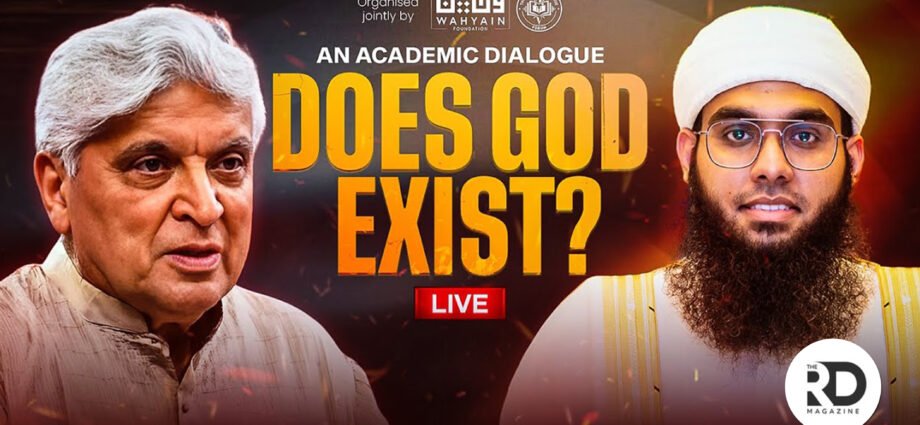
In an age where debates are reduced to sound bites and belief is often mocked as ignorance, the recent debate between Mufti Shamail Nadvi and Javed Akhtar was not merely an exchange of arguments; it was a confrontation between two worldviews. One worldview sees existence as meaningful, purposeful, and anchored in a higher order. The other views life as an accident, morality as negotiable, and suffering as proof of absence rather than mystery.
This blog stands unapologetically with Mufti Shamail Nadvi’s perspective, not because it dismisses questions or doubts, but because it recognizes something deeper: faith and reason are not enemies; they are companions when reason knows its limits.
The Question Itself: Is God a Scientific Problem or a Philosophical Reality?
One of the most important clarifications Mufti Shamail Nadvi made, perhaps the most overlooked by critics was this: “God is not a scientific hypothesis”
Science explains how things function within the universe. God addresses why the universe exists at all.
Demanding empirical proof for God is like asking a thermometer to measure justice. The tool is not wrong; but it is being misused.
Mufti Nadvi grounded his argument in classical metaphysics, a tradition far older and more rigorous than modern skepticism. He reminded the audience that everything we observe is contingent; it exists because something else caused it. This chain of dependency cannot logically regress infinitely. There must be a Necessary Being, uncaused, eternal, independent; what humanity across civilizations has called God.
This is not blind belief.
This is structured reasoning.
To reject this is not intellectual bravery, it is philosophical avoidance.
Suffering: The Emotional Argument That Feels Powerful but Isn’t Complete
Javed Akhtar’s strongest appeal was emotional. He pointed to suffering, war, innocent children, and injustice, asking: “How can a merciful God allow this?”
It is a question that has echoed through history. And it should disturb us. But disturbance is not the same as disproof.
Mufti Shamail Nadvi did not deny suffering, he contextualized it. Islam does not present a naive world where pain is an error in design. It presents a world where free will is real, and real freedom carries consequences.
If God intervened every time humans chose cruelty, freedom would be an illusion. Moral responsibility would collapse. Love would be programmed, not chosen.
Suffering, in the Islamic worldview, is not evidence of God’s absence; it is evidence of human agency and a temporary world. Justice is not denied; it is deferred.
The modern mistake is assuming that this life is the courtroom. Islam teaches that this life is the test, not the verdict.
The Atheist’s Moral Outrage
Ironically, many atheistic critiques rely on moral standards they cannot ground.
When Javed Akhtar condemns injustice, cruelty, and oppression, the question arises: “By what standard?”
If the universe is accidental and purposeless, then morality is subjective. Genocide and charity differ only by opinion. History has repeatedly shown where such thinking leads.
Mufti Nadvi subtly highlighted this contradiction: you cannot reject God and still demand ultimate justice. Outrage itself testifies to an innate moral compass; one that religion does not invent but recognizes.
Islam teaches that this moral awareness is fitrah: the natural disposition placed within every human being. Denying God does not erase it; it only leaves it unexplained.
Faith Is Not Fear
A recurring assumption in atheist rhetoric is that believers accept God out of fear or intellectual weakness. This assumption collapses under scrutiny.
Faith, as articulated by Mufti Shamail Nadvi, is not submission without thought; it is recognition of limitation. We accept that we did not choose our birth, our era, our parents, or the laws of physics. Why then is it humiliating to accept that existence itself may have a source beyond us?
Arrogance is not questioning God.
Arrogance is assuming the human mind is the final authority on reality.
True intellect bows, not in defeat, but in understanding.
Religion and Human Failure: A Crucial Distinction
Another frequent argument raised was the misuse of religion by humans. History indeed records bloodshed in the name of faith. But Mufti Nadvi’s position implicitly and correctly separates religion from religious people.
Islam does not claim that believers are infallible. It claims the opposite: humans are flawed, accountable, and in need of guidance. Corruption committed by humans does not indict divine truth; it indicts human betrayal of it.
To reject God because people misuse religion is like rejecting medicine because some doctors commit malpractice.
Why the Debate Felt Unresolved
Many viewers felt the debate lacked closure. That is because it was not a debate of facts, it was a debate of foundations.
One side spoke from within a worldview that accepts metaphysics, purpose, and accountability beyond death. The other rejected these premises entirely. Without shared foundations, arguments pass each other like parallel lines. But silence at the end of an argument does not mean equality of strength. Sometimes it means one side refuses to enter the terrain where answers exist.
The Quiet Strength of Mufti Shamail Nadvi’s Position
Mufti Shamail Nadvi did not shout. He did not mock. He did not perform. He did something far more difficult in today’s age: he reasoned with calm conviction.
His argument was not designed to “win” applause. It was designed to remind us that faith has intellectual depth, moral coherence, and spiritual humility. In a world addicted to certainty without accountability, belief in God remains the most radical assertion of all:
⦁ That life has meaning,
⦁ That justice will be completed,
⦁ That human arrogance is not the final word.
Final Thoughts
Islam teaches us that guidance is not forced, it is gifted. So this reflection does not end with condemnation or triumph. It ends with hope.
Aey Allah,
You are the Turner of hearts. Guide us before we claim certainty.
Illuminate the hearts of those who question, including Javed Akhtar and all who stand where doubt feels safer than surrender.
Replace arrogance with humility, and restlessness with peace.
Let truth become beloved to them, not imposed upon them.
And guide us too, so that our faith is lived with mercy, wisdom, and sincerity.
Aameen.
