

Pakistani Prime Minister Shehbaz Sharif on Tuesday asked President Donald Trump for a two-week extension of his threat to wipe out the “whole civilization” of Iran unless Tehran strikes a deal that includes reopening the Strait of Hormuz.
Sharif in an X post also asked Iran’s leadership to agree to open up the strait for two weeks “as a goodwill gesture.”
“We also urge all warring parties to observe a ceasefire everywhere for two weeks to allow diplomacy to achieve conclusive termination of war, in the interest of long-term peace and stability in the region,” Sharif wrote.
The public plea from the leader of Pakistan, which has acted as a mediator between the warring powers, came hours before Trump’s deadline for Iran to either cut a deal or face massive strikes on its civilian infrastructure.
On Tuesday morning, Trump dramatically ramped up his threats, warning on Truth Social that “a whole civilization will die tonight, never to be brought back again” if no agreement is reached.
“However, now that we have Complete and Total Regime Change, where different, smarter, and less radicalized minds prevail, maybe something revolutionarily wonderful can happen, WHO KNOWS?” he wrote.
“We will find out tonight, one of the most important moments in the long and complex history of the World.”
The threat came after U.S. forces overnight struck military targets on Kharg Island, Iran’s main oil export terminal, a White House official confirmed to CNBC.
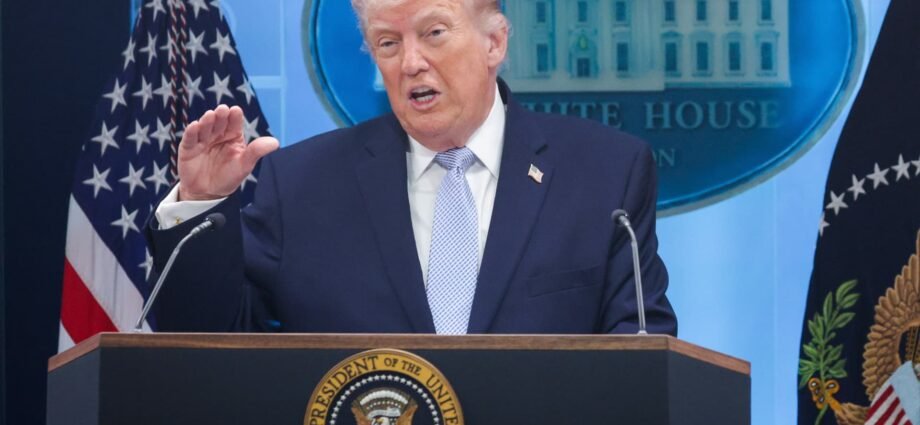
U.S. President Donald Trump speaks during a news conference in James S. Brady Press Briefing Room of the White House on April 06, 2026 in Washington, DC.
Alex Wong | Getty Images
Iran has blocked most oil transit through the Strait of Hormuz since the U.S. and Israel began the war in late February. The closure has led to a historic oil supply shock, which quickly sent global energy prices soaring.
Trump has boasted that Iran’s military has been “obliterated” but acknowledged it still controls ship traffic flow through the strait, giving it key leverage.
In a belligerent Easter social media post on Sunday, he threatened to destroy Iran’s bridges and power plants by Tuesday night, demanding Tehran “Open the Fuckin’ Strait, you crazy bastards, or you’ll be living in Hell.”
He later set a deadline of 8 p.m. ET on Tuesday.
Tuesday’s post, and the reports of new U.S. and Israeli strikes on Iranian infrastructure, gave way to conflicting reports on the status of diplomatic efforts between the warring powers.
Status of U.S. talks with Iran
The New York Times, citing three senior Iranian officials, reported that Iran has stopped negotiation efforts with the U.S. and told Pakistan, which has acted as a mediator, that it would end ceasefire talks.
The Wall Street Journal reported that Iran has cut off “direct communications with the U.S.” in response to Trump’s post, but that talks with ceasefire mediators are still active.
Iran’s Tehran Times newspaper, meanwhile, said in an X post, “Diplomatic and indirect channels of talks with the US are not CLOSED.”
The White House declined CNBC’s request for additional comment on Trump’s latest post, which quickly drew heated reactions from his enemies and some who have long been aligned with his MAGA political movement.
“Congress must immediately end this reckless war of choice in Iran before Donald Trump plunges us into World War III,” House Minority Leader Hakeem Jeffries, D-N.Y., said on X. “It’s time for every single Republican to put patriotic duty over party and stop the madness.”
Republican former Rep. Marjorie Taylor Greene, a onetime Trump loyalist who left Congress in January after publicly falling out with the president, called for his removal from office via the 25th Amendment.
Great Britain, meanwhile, is not allowing the U.S. to use its bases as part of any operations targeting civilian infrastructure, which could be considered a war crime, U.K. news outlet The i Paper reported.
A spokesperson for the British Ministry of Defence told CNBC it has authorized the U.S. to use its bases for “specific defensive operations to prevent Iran firing missiles into the region, which is putting British lives at risk.”
“We won’t be providing a running commentary on our allies’ operations, including their use of our bases,” the spokesperson added.
Trump has frequently fumed about the reluctance of the U.K. and other allies in the North Atlantic Treaty Organization to involve themselves in the Iran war, even as he claims the U.S. does not need any help.
The relationship between the U.S. and the alliance was deeply strained earlier this year, when Trump demanded that the U.S. must take control of Greenland, an autonomous territory ruled by NATO member Denmark.
Trump’s saber-rattling toward Greenland subsided, but he signaled Monday that he remains upset with NATO over Europe’s opposition to his efforts to seize the island.
“You know, it all began with, you want to know the truth, Greenland,” Trump said at the end of a White House news conference on Monday. “We want Greenland. They don’t want to give it to us. And I said, ‘Bye, bye.'”
Trump’s terms for Tuesday deal
At the news conference, Trump said that for Iran to stave off the Tuesday deadline, it would have to agree to “a deal that’s acceptable to me, and part of that deal is going to be, we want free traffic of oil and everything else.”
Trump has criticized Iran’s talk of tolling the strait and has signaled his interest in the U.S. imposing its own tolls there instead.
The U.S., Iran and regional mediators in the Middle East were reportedly discussing a 45-day ceasefire proposal as a last-ditch attempt to avoid triggering Trump’s looming deadline.
But a White House official told CNBC on Monday morning that Trump has not backed that idea, and Iran has explicitly rejected any temporary ceasefire, calling instead for a deal to end the war permanently.
“The only one that’s going to set a ceasefire is me,” Trump told reporters at the White House Easter Egg Roll on Monday when asked about the proposal.
Vice President JD Vance said Tuesday morning in Hungary that the U.S. strikes on Kharg Island are consistent with Trump’s military strategy and his looming deadline for Iran.
“The deadline is 8 o’clock,” Vance said in Budapest, where he had traveled to support Hungarian Prime Minister Viktor Orban’s reelection bid.
“What Iran is trying to do, because they’ve been defeated militarily, is they’re trying to extract as much economic pain on the world as possible, and the president of the United States is a man who recognizes leverage,” he said.
Trump has insisted the Iranian people want the U.S. to keep up its military operations even if it puts them at risk, because they have lived in a “violent, horrible world” under the repressive ruling regime.
“They would be willing to suffer that in order to have freedom,” he said at Monday’s news conference. “We’ve had numerous intercepts, ‘Please keep bombing.’ Bombs that are dropping near their homes. ‘Please keep bombing. Do it.'”
But Trump has also argued that Iran’s new regime, which replaced the many top officials killed by the U.S. and Israel during the war, is more reasonable and less radical.
Not everyone agrees. JPMorgan research analysts said in a Monday client note that the conflict has empowered the Revolutionary Guard and that Iran’s strategy is based around its ability to outlast, rather than outgun, its opponents.
“Iran may have lost its supreme leader and commanders, and suffered severe damage to nuclear facilities and military assets, but there are no signs of capitulation,” they wrote.
— CNBC’s Jackson Peck contributed to this report.
