
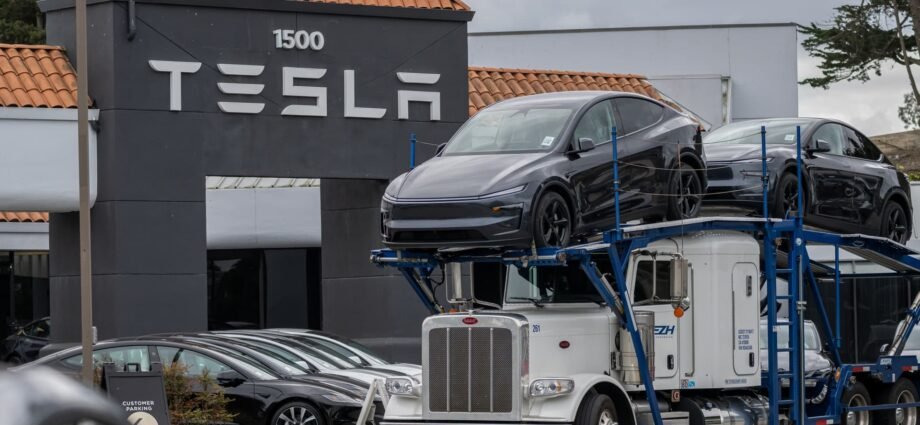

Tesla shares dropped more than 5% on Thursday after the company’s deliveries and production report for the first quarter showed a drop from the prior period, with mild growth from a year earlier. Tesla has recorded annual declines in the past two years.
Here are the key numbers:
- Total Q1 vehicle deliveries: 358,023
- Total Q1 vehicle production: 408,386
Analysts were expecting 370,000 deliveries, according to StreetAccount estimates, while a company-compiled consensus by Tesla, published on March 26, said the average estimate was for 365,645 deliveries in the first quarter.
Deliveries improved 6% from a year ago, when Tesla reported 336,681. The first quarter of 2025 marked a decline of 13% over the first quarter of 2024. Tesla’s total deliveries for 2025 fell to 1.64 million from 1.79 million in 2024.
With Thursday’s drop, the steepest this year, the stock is down almost 20% in 2026.
Tesla’s entry-level Model 3 sedan and most popular Model Y SUVs accounted for 341,893 for the quarter, the company said in the latest report. Deliveries are the closest approximation of sales reported by Tesla, but are not precisely defined in the company’s shareholder communications.
While CEO Elon Musk has been refocusing the company to produce a driverless Cybercab and Optimus humanoid robots, Tesla has yet to sell those products and still relies on auto sales for the bulk of its revenue. In January, Tesla announced it was ending production of its flagship Model S and X vehicles, and would use the factory lines where they were assembled in Fremont, California, to build Optimus robots.
The S and X had long been in decline for Tesla. The 3 and Y accounted for 97% of the company’s deliveries last year.
Musk said in a post on his social network X on Wednesday that orders of the S and X have “come to an end,” but some were left in inventory. “We will have an official ceremony to mark the ending of an era. I love those cars,” he added.
The angular, steel Cybertruck, which Tesla started delivering to customers in late 2023, has not become a mainstream success. Tesla is poised to ramp up deliveries of its fully electric Semi in 2026, a class 8 truck with a promised range of 500 miles.
In its energy business, Tesla said that it deployed 8.8 gigawatt hours of battery energy storage systems in the first quarter, following a record of 14.2 gigawatt hours in the fourth quarter of 2025. In Q1 of 2025 the company deployed 10.4 GWh of its energy products.
Tesla’s battery energy storage products include its Powerwall backup batteries for homes, and larger Megapack and Megablock systems used alongside data centers and utilities.
William Blair equity analysts, led by Jed Dorsheimer, said in a note Thursday that they were not surprised by Tesla’s automotive numbers because “global EV demand ex-China remains under pressure, and Tesla is actively sacrificing its EV business in favor of a fully autonomous future.”
However, Tesla’s whiff on energy was of greater concern.
“This business can be lumpy and swing depending on customer grid hook-up timing, but that does not fully explain this drop-off,” the note said. “We are confused as to what happened with supply this quarter.”
Tesla shares dropped 15% in the first quarter, continuing a trend that started two years ago. The stock plunged from January through March in 2024 and 2025 but rose in every other quarter to end the years higher.
Tesla’s 2025 vehicle sales slump stemmed from increased competition across the globe, and a consumer backlash against Musk in response to his politics. In addition to Musk’s financial support for President Donald Trump and his work for Trump’s second administration, the Tesla CEO has endorsed Germany’s anti-immigrant extremist party AfD, and anti-Islam activist Tommy Robinson in the UK, among others.

Tesla year-to-date stock chart.
Tesla, and the broader U.S. EV market, was also hurt by the end of a $7,500 federal incentive for the purchase of new EVs in September.
But sales of used electric vehicles have been on the rise since the U.S. and Israel launched strikes against Iran in late February, sparking a conflict that’s sent oil prices soaring.
Iran has retaliated by targeting ships trying to pass through the Strait of Hormuz.
Tesla’s automotive gross margins and supply chain disruptions are likely to be in focus when the company reports first-quarter earnings on April 22.
WATCH: Tesla reports Q1 deliveries
