
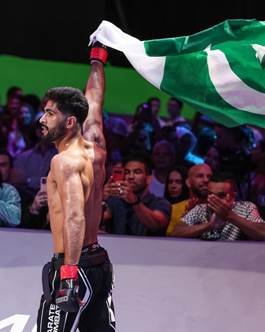
When Shahzaib Rindh steps into an arena, the atmosphere shifts. His fighting style is aggressive but calculating, his aura powerful, and his narrative rich in difficulty and toughness. To Pakistan, and particularly to his native province of Balochistan, Rindh is no longer just a combatant. He stands as a testament to determination, serving as a reminder that heroes can emerge from humble origins.
Childhood Shadows: Combating Before the Arena
Rindh’s journey to martial arts was not a refined one. Raised in Quetta, he was brought up in a family that had limited resources; his mother was at home, and his father was working as a civil servant. Growing up in Balochistan was never simple, and his personality as a child only contributed to the problems. Famous for fighting on the streets, he would return home battered, his family worried about where his militancy would take him.
His older brother recognized the need to take action. To channel Shahzaib’s energy, he signed him up for a local wushu sanda gym. What began as a means to keep him out of trouble soon revealed a hidden talent.
On his first day in the gym, young Rindh was subjected to a sparring bout with an older, veteran fighter. He went home with a broken nose and tears in his eyes, but also with a determination he had never experienced before. Instead of pushing him away, that painful initiation turned him on. From that moment on, martial arts was no longer a hobby. It became his vocation.
Wushu as Foundation
Wushu sanda training was a turning point. In contrast to the street fighting’s randomness, wushu provided structure to his natural ferocity. Its mix of punches, kicks, and throws required balance, patience, and control. Gradually, his attitude changed. The kid who used to fight on impulse was gradually learning restraint, redirecting his energy into competitions and training.

His parents were careful, particularly his mother, who fretted about his safety all the time. Still, she encouraged his pursuit, praying for him every time he stepped into a ring. The state of the family finances necessitated sacrifices. They enabled Rindh to test himself against tougher competition, to gain confidence, and to envision a future where combat was not merely about survival; it was a career.
Rising Through National and Regional Stages
By the time he was in his late teens, Rindh was more than just one of the many students at the gym. He was a six-time national champion in various combat sports, not merely dominating in wushu but also dominating kickboxing, wrestling, boxing, and taekwondo. Sanda’s adaptability had made it simpler to switch from one discipline to another.
These triumphs did not come quickly. He trained repeatedly in poorly equipped gyms, with no state-of-the-art facilities or big support staff. Many a day, he trained by himself, watching tape, working on technique, and pushing his body as strongly as he could. Injuries were inevitable, but giving up was never in the cards. The tougher the conditions, the clearer his determination.
The Dubai Showdown: More Than a Fight
Though he had already established himself at a national level, it was the Dubai Karate Combat 45 event (April 2024) that took Rindh to international headlines. The evening was advertised as a Pakistan vs. India clash with national pride hanging in the balance.
The team score stood at 1–1 when Rindh faced India’s Rana Singh in the pit. It was not another bout; it was the decider. For the people watching, the drama was evident. For Rindh, it was a chance to test himself on a platform bigger than any of his past performances.

What ensued was a clinic in precision and emotion. He pounded relentlessly ahead, establishing his pace and taking charge of Singh. By the time the referee held up his hand in triumph, Pakistan had achieved a 2–1 team victory. The arena exploded.

But what made the moment memorable wasn’t just the victory. Following the epic struggle, Rindh waved both the Pakistani and Indian flags in the air, proclaiming: “This fight was for peace. We are not enemies. Together we can do anything.”In a sport renowned for competition and bluster, his message of harmony struck a powerful chord, reminding spectators that sport can overcome boundaries.
World Champion in Singapore
The Dubai victory was only the start. In a later event that same year, Rindh took the stage at Karate Combat 49 in Singapore against Brazil’s Luiz Victor Rocha. This was not a team match; it was a competition for the World Light Heavyweight Championship.

Against Rocha, he displayed the calm of an old pro. Where previous fights had been about brute strength, this fight was about maturity. He combined smart strikes with intelligent movement, outmaneuvering his man. And when the decision was read aloud, Shahzaib Rindh had become the first Pakistani world champion in Karate Combat.
His triumph was historic, not just for him but for the nation as well. In Pakistan, a country that rarely celebrates its athletes on the international combat sports stage, Rindh’s success marked a significant milestone.
The Hero’s Welcome and Harsh Realities
Back in their homeland, Rindh was welcomed as a national hero. Islamabad and Quetta airports were filled with adoring fans shouting his name. Government officials queued up to offer him accolades. President Asif Ali Zardari handed him a cheque, and the Balochistan provincial government gave him 2 million rupees and a government position.

But under the fanfare, Rindh expressed his disillusionment. Time and time again, he said, leaders had promised and never delivered. Fighters such as him too often went without institutional backing, having to pay for training and transport themselves. To him, the issue wasn’t merely reward; it was about investing in sports in the long term. He called out openly for the government to support young athletes and to give them facilities and platforms so the next generation wouldn’t have to undergo the same hurdles.
Dreaming of a Sports Academy
For Rindh, the coming step is not just about title defenses but about giving back. He has talked about opening a sports academy in Balochistan, where young fighters can train with proper equipment and under guidance, and with hope.
His experiences are the inspiration for his vision: training in bare-bones gyms, making do often with willpower rather than money. If he can keep the next generation from having to go through that, then he thinks Pakistan can turn out not one, but numerous world champions.
Lessons from His Life
Shahzaib Rindh’s life has a few lessons to impart:
- Adversity can be a starting point. What started as street brawls and childhood violence became the spark for a life of disciplined dedication.
- Support from the family counts. From his brother, who introduced him to wushu, to his mother’s prayers, the role played by his family was crucial.
- Perseverance is an arsenal. Broken noses, economic hardship, and institutional abandonment never discouraged him.
- Victory can be metaphorical. His Dubai victory was not about beating India; it was about supporting peace and harmony.
- Champions are leaders. By promoting academies and sports development, he demonstrates that sportspersons can be voices of change.
Conclusion
From an energetic kid battling in Quetta’s streets to an international champion basking in glory on global platforms, Shahzaib Rindh’s life is one of hard work and change. His Dubai and Singapore victories established him in the annals of history, but it is the narrative behind such triumphs—the trials, the compromises, and the hope for a brighter tomorrow—that transforms him into an icon.
For Balochistan and for Pakistan, his triumph is evidence that champions need not come from places one would expect. And for the world martial arts community, he is a reminder that the battle is never only in the ring; it is also in the path one must travel to get there.
Author: Alishbah Yaser
