
Evercore ISI thinks shutdown will be ‘relatively short’
Evercore ISI strategist Sarah Bianchi doesn’t expect a long government shutdown after a few Senate Democrats voted for a stopgap funding bill last night that ultimately fell short of the required votes.
“Three Senate Democrats voted for the bill tonight, offset by one Republican against. There are certainly five more Senate Democrats who are uncomfortable with shutdowns and will not want this to go on very long, especially if the threat of federal worker layoffs becomes more real. Given this, and the fact that Republican leaders already have expressed openness to negotiating on health care, we think the shutdown will be relatively short,” she wrote in a note.
— Fred Imbert
U.S. government shutdown could hurt real economy, Milken Institute chief economist says
William Lee, chief economist at the Milken Institute, noted this shutdown could have a greater impact on the economy than previous ones.
“The history of shutdowns really has had so little impact on the real economy because essentially, by the end of the shutdowns, everything goes back to the way it was,” he said Wednesday in a “Worldwide Exchange” interview. “But this time there may be some big changes because both sides are being very strategic about it. The Republicans are saying, ‘this is a good time for us to implement the kind of changes Elon Musk put in place with DOGE.’ … The Democrats are really bearing down and saying, ‘this is our turn to be strategic and get back the legislation we want to put in place.”
He added that both sides are playing more “chess than checkers.”
— Fred Imbert
Stock futures fall as U.S. government shuts down
U.S. stock futures were under pressure Wednesday after lawmakers failed to reach a deal that would avoid a government shutdown.
Futures tied to the Dow Jones Industrial Average dropped 241 points, or 0.5%. S&P 500 futures shed 0.6% along with Nasdaq-100 futures.
— Fred Imbert
How the shutdown will affect major economic reports
A sign advertises a government shutdown relief loan progaram outside of the United States Senate Federal Credit Union branch office in the Hart Senate Office Building in Washington on Tuesday, September 30, 2025.
Bill Clark | Cq-roll Call, Inc. | Getty Images
A shutdown could delay the release of key economic reports that the government regularly publishes, which are closely watched by financial markets.
In a contingency plan released Friday, the Labor Department said that the Bureau of Labor Statistics, the agency that produces the government reports on the economy, will “suspend all operations” in the event of a shutdown.
“Economic data that are scheduled to be released during the lapse will not be released,” the plan said.
The next BLS employment report was set to be released Friday. The BLS’s Consumer Price Index reading for September is scheduled to be released on Oct. 15.
Wells Fargo economist Michael Pugliese noted last week that after the last full government shutdown in 2013, the monthly jobs and consumer price index reports “were delayed by about two weeks.”
“Collection, processing and publication delays stretched into the following month as well,” Pugliese noted.
In the partial shutdown that began in late 2018, Pugliese noted, “the first look at” gross domestic product growth for the fourth quarter of that year “was delayed about a month, as was December 2018 data on retail sales and personal income & spending.”
— Kevin Breuninger and Jeff Cox
European markets edge higher as U.S. government shutdown holds spotlight
European markets were slightly higher during early morning deals, as global investors monitor the U.S. government shutdown.
The pan-European Stoxx 600 index was up 0.1% shortly after the opening bell, with sectors and major bourses pointing in opposite directions.
— Chloe Taylor, Tasmin Lockwood
Markets likely to shrug off shutdown impact, Aberdeen economist says

Market participants are likely to brush off the impact of the government shutdown, according to Luke Bartholomew, deputy chief economist at Aberdeen, particularly if it proves to be a short-term issue.
Asked whether investors were likely to take issue with the shutdown, Bartholomew replied: “Probably not, to be honest. I mean, if it was bound up with the debt ceiling issue as they have been in the past then potentially there’s risks around that, but I would be surprised if the market doesn’t ultimately shrug this off.”
Bartholomew conceded there are questions about data availability, with the closely watched nonfarm payrolls report not expected to be released on Friday because of the shutdown.
“Maybe that influences the Fed in some way. Although they do have a wide variety of other private sector data that they can rely on,” Bartholomew told CNBC’s “Squawk Box Europe.”
— Sam Meredith
How Republicans and Democrats are blaming each other for the shutdown
Senate Minority Leader Charles Schumer, D-N.Y., right, and House Minority Leader Hakeem Jeffries, D-N.Y., conduct a news conference after a meeting with President Donald Trump, Speaker of the House Mike Johnson, R-La., Vice President JD Vance, and Senate Majority Leader John Thune, R-S.D., about avoiding a shutdown ahead of the deadline to fund the government, at the White House on Monday, September 29, 2025.
Tom Williams | Cq-roll Call, Inc. | Getty Images
Republicans, who hold the White House and slim majorities in both chambers of Congress, wanted to pass a stopgap bill to maintain funding at current levels until late November. They needed at least seven Democrats to help them in the Senate, where 60 votes are required to overcome the filibuster.
Senate Minority Leader Chuck Schumer, D-N.Y., and a group of Democrats had previously joined Republicans in March to pass a six-month extension of government funding.
But this time around, Democrats have united around several demands, including that any short-term funding bill include an extension of enhanced Obamacare tax credits, which are due to lapse at year’s end. The enhanced subsidies reduce the costs of health insurance premiums for a wider swath of Affordable Care Act enrollees.
Republicans balked, accusing Democrats of holding the government hostage by standing in the way of continued federal funding unless their health-care demands are met.
GOP leaders have also argued that their “clean” continuing resolution is nonpartisan, and that policy negotiations can continue without shutting down the government.
Democrats countered that the GOP proposal actually is partisan, since Republicans are seeking to extend funding following the passage of a controversial spending bill that narrowly passed in July over the objections of all congressional Democrats.
Democrats have also slammed Republicans for refusing to negotiate, and for leaving Washington, D.C., as the shutdown deadline approached.
Trump and other Republicans have also accused Democrats of seeking to give health-care benefits to undocumented immigrants — a claim that Democrats reject as a lie, noting that federal law prohibits it.
— Kevin Breuninger
Trump: ‘We can do things during the shutdown that are irreversible’
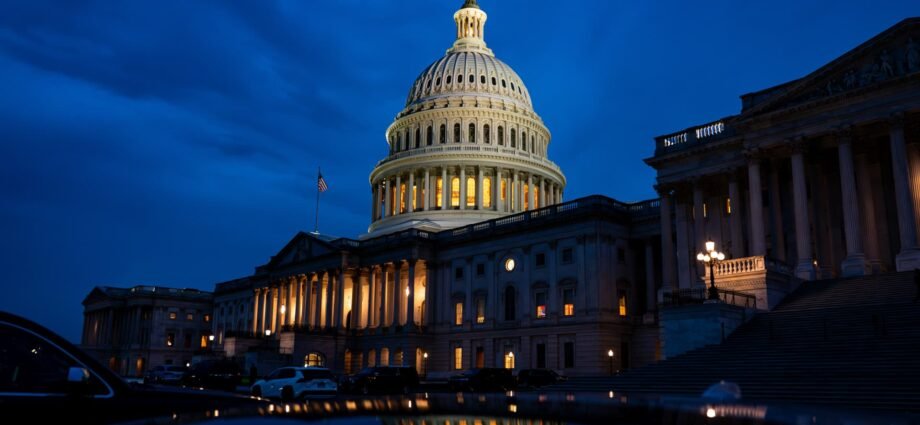
The U.S. Capitol stands in Washington, D.C.
Bloomberg | Bloomberg | Getty Images
While insisting that Republicans do not want to shut the government down, Trump said his administration could exploit the situation to hurt Democrats.
“We can do things during the shutdown that are irreversible, that are bad for [Democrats],” Trump said at the White House on Tuesday, “like cutting vast numbers of people out, cutting things that they like, cutting programs that they like.”
That could include cutting “large numbers of people” on government benefits, Trump said, before quickly adding, “We don’t want to do that, but we don’t want fraud, waste and abuse.”
— Kevin Breuninger
‘Democrats Have Shutdown the Government’: White House webpage says
The US Capitol in Washington, DC, US, on Tuesday, Sept. 30, 2025.
Graeme Sloan | Bloomberg | Getty Images
“Democrats Have Shutdown the Government,” a White House webpage said right after midnight, featuring a clock detailing the time that has passed since the shutdown began.
But California Gov. Gavin Newsom, a Democrat, said on X, “Donald Trump just shut down the government,” underscoring the fact that both parties blame the other for the dramatic pause in federal services and functions.
Former Vice President Kamala Harris posted on X: “President Trump and Congressional Republicans just shut down the government because they refused to stop your health care costs from rising. Let me be clear: Republicans are in charge of the White House, House, and Senate. This is their shutdown.”
— Dan Mangan, Riya Bhattacharjee
How many workers could be furloughed?
WASHINGTON, MARCH 4:
U.S. Capitol Police close a security gate along 1st Street Northeast on Capitol Hill in Washington, on March 4, 2025.
The Washington Post | The Washington Post | Getty Images
During the last full government shutdown in 2013, about 850,000 federal employees were furloughed, meaning they were required to take unpaid leave, according to the Committee for a Responsible Federal Budget.
The Congressional Budget Office estimated Tuesday that the current shutdown would lead to about 750,000 employees being furloughed.
“The total daily cost of their compensation would be roughly $400 million,” the CBO told Sen. Joni Ernst, R-Iowa, in response to her request for information on the impact of a shutdown.
The agency’s estimate noted that the number of furloughed employees could vary from day to day “because some agencies might furlough more employees the longer a shutdown persists and others might recall some initially furloughed employees.”
Furloughed workers will get back pay upon their return.
But Trump’s Office of Management and Budget has threatened to make some of those job cuts permanent, by warning federal agencies in a recent memo to prepare for mass firings in the event of a shutdown.
— Kevin Breuninger
Government shutdown history: The longest was under Trump
U.S. President Donald Trump speaks in the Oval Office, on the day he signs an executive order on AI and pediatric cancer research, at the White House, Washington, D.C., U.S., Sept. 30, 2025.
Nathan Howard | Reuters
The full shutdown began at midnight Wednesday after Democratic and Republican leaders failed to agree on even a short-term deal to keep the government fully funded past the current fiscal year.
It is unclear just how long the shutdown will last, or how widespread its impacts will be.
The federal government has either shut down or experienced funding gaps 14 times since 1980.
The longest shutdown on record started in late 2018, when the government partially shuttered for about five weeks amid disputes over funding Trump’s proposed U.S.-Mexico border wall.
— Kevin Breuninger
